
 English
  Portuguese
  Spanish
Sensor-Activated Faucets: A Success Case in the Aviation Market
Have you ever wondered why many new commercial aircraft are transitioning from traditional mechanical faucets to touchless activation solutions? Atfirst glance,the answer behind this shift may seem obvious: hygiene.
In fact, touchless faucets gained significant recognition during the pandemic as a way to reduce contact with contaminated surfaces. And yes, they do help create a cleaner and safer lavatory experience. However, the business case for touchless faucets goes beyond hygiene.
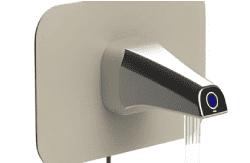
An important, though less obvious, advantage is weight reduction. Since the water flow is electronically controlled by a solenoid valve, the faucet mechanism can be more compact and lighter than traditional mechanical systems. In industries where every gram matters,this benefitis significant.
Another key advantage is water savings. Touchless faucets help control water flow more precisely, activating it only when needed and automatically shutting it off afterward
This reduces unnecessary consumption and helps optimize the onboard water supply. For airlines, saving water is not only an environmental matter; it also improves operational efficiency and enhances the passenger experience during the flight.
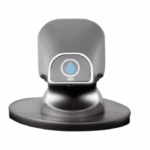
Touchless technology can also help keep the lavatory cleaner during operation. With mechanical faucets, passengers often need to alternate their hands while washing: while one hand presses the faucet, the other is rinsed, and vice versa; this often causes water to splash around the sink area. A touchless system creates a smoother experience, eliminating the need to alternate hands, which ultimately improves the overall cleanliness of the lavatory.
However, the greatest operational benefit may come from increased durability and reduced maintenance costs. Mechanical faucets are subject to direct passenger contact, which leads to excessive wear caused by frequent and often improper use.
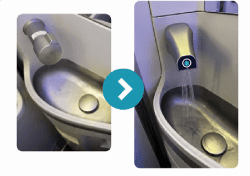
For many operators, keeping lavatory faucets operational is a recurring task, requiring dedicated repair benches and frequent replacement of components. By eliminating direct mechanical contact and electronically controlling the water flow, touchless faucets can extend service life, reduce maintenance requirements, and lower operational costs. This represents a significant advantage for airlines in a market where the search for operational costreduction is constant.
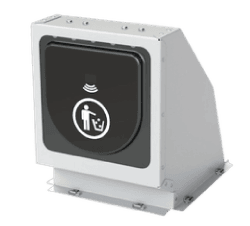
Adams Rite Aerospace, a recognized supplier of water and waste system solutions, offers its Touchfree™ Faucet, specifically developed for aircraft applications. The company has also expanded its Touchfree™ conceptto provide a more complete touchless lavatory experience. In addition to the faucet, the Touchfree™ solutions include an automatically lifting toilet seat lid, automatically opening waste bin lids, and touchless flush activation
All these devices have been adapted to operate withoutrequiring physical contactfor activation.
For passengers,this means a cleaner, safer, and more modern experience.
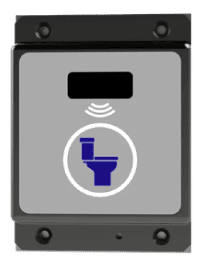
For airlines, it represents a real opportunity to improve reliability, reduce maintenance costs, minimize water waste, and enhance the overall cabin experience.
In the aviation market, touchless technology goes beyond hygiene. It represents efficiency, durability, sustainability, cleanliness, and smarter operations.