 English
  Portuguese
  Spanish
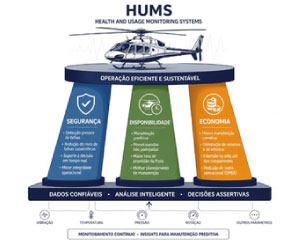
The Three Pillars: Safety, Availability, and Efficiency
Introduction:
Brazil has one of the largest helicopter fleets in the world, with approximately 1,300 active aircraft registered by ANAC, distributed among private and public operators. Most of this fleet operates in the civil sector, including executive aviation, offshore transportation for the oil and gas industry, air taxi services, and specialized missions. The public-sector fleet, which includes the armed forces, police units, fire departments, and aeromedical operations, represents approximately 20 to 30% of the active fleet.
The concentration of this fleet is particularly significant in the Southeast region, especially in the city of São Paulo, which historically hosts one of the largest urban helicopter fleets in the world. This scenario reflects the importance of helicopters as a mobility, safety, and support solution for strategic activities throughoutthe country.
Given this volume and diversity of operations, many of them conducted in critical or remote environments, ensuring high availability and operational safety becomes essential. In this context, aircraft health monitoring systems have gained increasing prominence.
What is a Health Monitoring System?
A health monitoring system, internationally known by the acronym HUMS (Health and Usage Monitoring Systems), combines onboard sensors, data acquisition modules, and advanced analytics to monitor, in nearrealtime,the structural condition and performance of critical components, such as:
- Main transmission and gearbox assemblies.
- Main and tailrotor systems.
- Shafts and bearings.
- Engines and auxiliary systems.
The most common sensors include accelerometers (vibration), although rotational speed, temperature, and pressure sensors are also used. The data are processed onboard and/or on the ground, allowing trends and anomalies to be identified before they develop into failures.
How HUMS Increases Availability
Availability is the ability of an aircraft to be ready to perform a mission when required. HUMS contributes directly through three main mechanisms:
1.Predictive maintenance (condition-based maintenance):
- Instead ofreplacing components based solely on flight hours, maintenance activities are driven by the actual condition ofthe systems. This approach avoids unnecessary replacements and enables early intervention when degradation is detected.
2.Reduction of unplanned downtime
- By identifying early signs of wear—such as changes in vibration patterns—the system allows maintenance to be scheduled before a failure occurs,reducing unexpected downtime events.
3.Logistics and spare parts optimization
- With greater predictability, operators can better plan inventories, component procurement,equipment allocation, maintenance teams, and maintenance windows,reducing aircraft downtime and improving operational efficiency
The result is a higher level of aircraft readiness and more effective fleet utilization.
Reduction of Catastrophic Failure Risk
Catastrophic failures in helicopters are often associated with critical rotating components. HUMS acts as an important additional layer of safety:
- Early detection of bearing and gearfailures
- Advanced vibration analysis techniques enable the identification of micro-defects before they become critical.
- Structuralfatigue monitoring
- Tracking actual aircraft usage (loads, cycles, and operating regimes) makes it possible to estimate component service life with greater accuracy.
- Operational alerts
- In more advanced systems, critical anomalies can generate immediate alerts forflight crews and maintenance personnel.
- Data foundation for prevention
- Operational history enables deeper analyses, contributing to continuous improvements and failure prevention across the entire fleet.
Technologies and Recent Developments
The new generation of monitoring systems incorporates:
- Artificial intelligence and machine learning
- Real-time data transmission
- Integration with maintenance systems (MRO)
- Digitaltwin models
These technologies enhance predictive capabilities and make maintenance activities even more efficient.
Panair LLC partners with RMCI inHUMS technology
RMCI is at the forefront of Aircraft Health and Usage Monitoring Systems (HUMS) and data analytics. The company has extensive experience supporting both government and private-sector operators, including more than 10 years of experience monitoring the condition of over 3,000 helicopters in support of the U.S. Army. RMCI employs a highly skilled team of engineers, scientists, and support personnel with expertise in vehicle health management, helicopter drivetrain systems, hardware and software design, vibration and acoustics engineering, statistics, and data analytics
Expandable Rotorcraft Diagnostic System (XRDS):
The XRDS system, developed by RMCI, is a highperformance software platform designed for predictive mechanical diagnostics and operational quality assurance in helicopter fleets. Its architecture integrates advanced analytics tools, enabling signal processing and early fault detection in rotating and structural components.

Technical Capabilities:
- Component monitoring: gearboxes, bearings, shafts, engines, and rotor systems.
- Multiple fault detection: corrosion in rotating components, bearing defects (races, balls, or rollers), geartooth defects, shaft dynamic imbalance, angular and parallel misalignment, manufacturing defects (e.g., eccentricity and clearances), and installation errors.
- Features for helicopter operators: advanced mechanical diagnostics (vibration analysis, harmonic signature analysis, and envelopedemodulation), Flight Operational Quality Assurance (FOQA), and advanced rotor balancing (rotor smoothing with multi-plane correction).
Infrastructure and Implementation:
- Multi-channel connectivity: enabled forflightline operations, mobile devices, and web-basedenvironments.
- Associated hardware: lightweight electronics and modern sensors (MEMS, IEPE, or broadband piezoelectric sensors), with integrated signal conditioning.
- Modularity: compatible with fleets of any size, from light aircraftto heavy rotorcraft platforms.
Fleet Condition Monitoring:
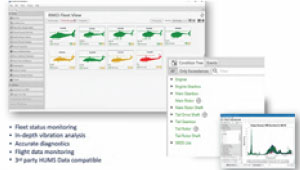
XRDS provides a centralized view offleet condition by consolidating data from multiple aircraftinto a single platform:
- Each aircrafttransmits flight, vibration, and usage data;
- Information is aggregated on the ground (ground station/cloud environment);
- Operators gain a comparative view across the fleet.
This enables the identification of:
- Helicopters operating outside expected performance patterns;
- Differences in wearrates among aircraft within the same fleet;
- Operationaltrends (more demanding missions and flight profiles).
Ground-Based Flight Replay:
The RMCI CDRS (Cockpit Data Recording System) capability to replay monitored aircraftflights is one of the most valuable tools for operational analysis and safety, as it transforms raw flight data into a synchronized and accurate reconstruction of the mission, as if the flight were being reviewed from within the cockpit. This capability connects two dimensions that are typically analyzed separately:
- What happened during the flight (operations);
and
- How the mechanical systems responded (condition).
Without this correlation, analyses may remain incomplete orinconclusive.
Through flight replay, maintenance personnel can verify,for example, whether:
Within the operational context:
- A vibration event occurred during a high-torque condition;
- Variations were observed during aggressive maneuvers;
- The behavior was isolated orrecurrent.
Result: enables differentiation between a genuine anomaly and a normal operational effect.
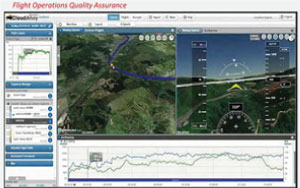
Cause-and-effect correlation (root cause analysis) allows operators to move beyond understanding “what happened” and determine “why it happened.”. It enables more reliable early fault detection. HUMS systems may occasionally generate false positives. Through ground-based replay, behavioral trends can be validated and alerts can be assessed fortechnical relevance, increasing diagnostic confidence.
It brings togetherthe two worlds of Maintenance and Operations. Engineering gains a better understanding of how the helicopter is being used, while operations personnel gain insight into the impact of usage on aircraft wear.
It enables the identification of severe usage conditions, which are often key drivers of component degradation.
It reduces unnecessary maintenance actions, with a direct impact on both operating costs and aircraft availability.
It provides valuable support for technical investigations when an actual failure occurs, making it an essentialtoolfor engineering and reliability teams. Finally, ground-based replay enables the advancement of true predictive maintenance practices.
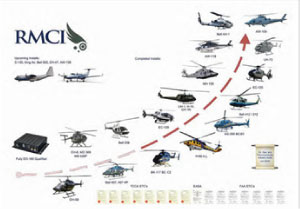
XRDS has already been certified by multiple certification authorities and approved for operation across a wide range of aircraft platforms
Applications in the Brazilian Context:
In Brazil, the use of health monitoring systems is particularly relevantin operations such as:
- Offshore transportation (oil platforms – in this sector, HUMS technology is already well established and, in some cases,required);
- Public safety and airborne law enforcement operations;
- Aeromedicalrescue missions;
- Intensive executive aviation operations.
In remote or mission-critical environments, the ability to anticipate failures can be a decisive factor in maintaining operational safety.
Conclusion:
Helicopter health monitoring represents a fundamental evolution in the way maintenance activities are conducted. By transitioning from a reactive model to a predictive approach, operators are able to:
- Significantly increase fleet availability;
- Reduce operational costs;
- Minimize the risk of catastrophic failures.