
 English
  Portuguese
  Spanish
AMSAFE Airbag System Airbag seatbelts are already widely used across various aircraft and have been responsible for saving countless lives.
Designed to withstand impacts of up to 16g, in compliance with FAR/CS 25.562, these systems provide effective protection for passengers of different body types in moderate-severity accidents. Unlike automotive airbags, which primarily protect against impacts of the body against vehicle structures, AMSAFE airbag seatbelts are designed to reduce deceleration and minimize traumatic injuries to the head and neck.
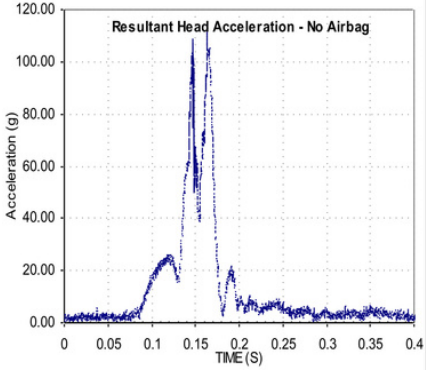
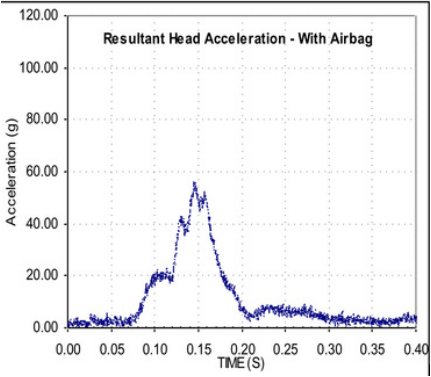
Comparison of acceleration peaks: on the left, accelerations experienced by the head of an occupant in a seat without airbags.
On the right, values measured with airbags. This reduction in peak deceleration values significantly increases the chances of survival, ensuring that occupants remain conscious and able to evacuate the aircraft or perform safety procedures afterthe incident.
Structure and Operation The system is remarkably simple and efficient, consisting of three main elements:
- Electronic module: contains impact sensors and an
independent power source. - Inflators: responsible for releasing compressed gas that
inflates the airbags. - Seatbelts: with integrated airbags
System Components: the electronic module (01), the inflators (02), and the airbag seatbelts (03).
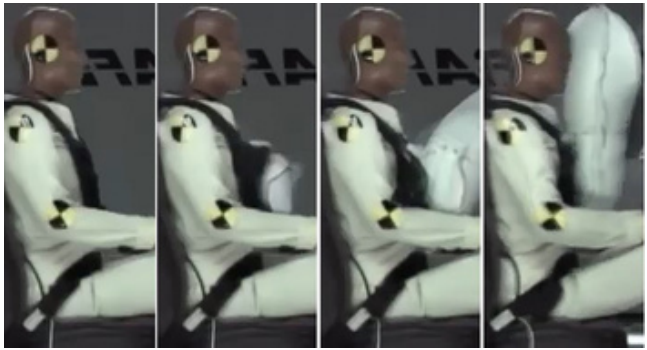
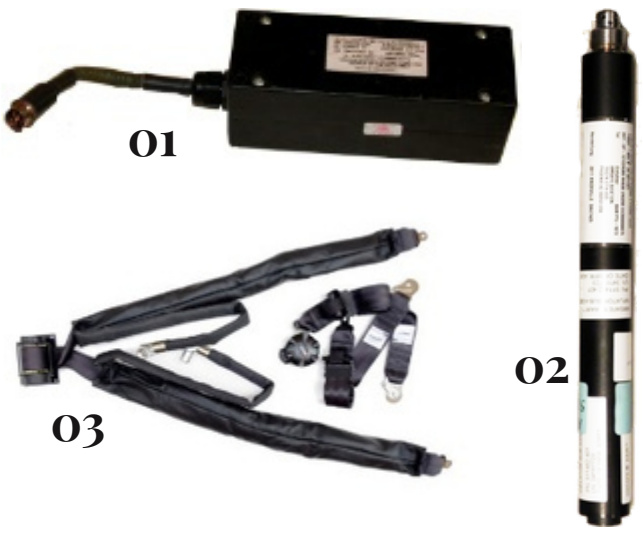
In the event of an accident, when the sensor detects a deceleration of 9g, the module sends an electrical signal to the inflators. These instantly release highly compressed gas into the airbag cushions. The airbag cushions deploy in fractions of a second, breaking the enclosure seams and filling the space in front of the passenger.
Safety Features Despite its simplicity, the AMSAFE airbag seatbelt system has several very important characteristics:
- Full autonomy: the system does not depend on aircraft power or any other onboard system, remaining active even in the event of a complete electricalfailure.
- Automatic operation: system activation requires no action from the pilot, crew, or passengers — simply fasten the seatbelt.
- Immunity to false activations: the sensor responds only to decelerations along the flight axis, remaining insensitive to turbulence, runway irregularities, or hard landings. In other words, there is no risk of activation when the aircraft operates within its certified limits.
Airbags
Unlike automotive systems, AMSAFE airbags do not use pyrotechnic devices. The cushions are inflated with inert, non-toxic, and nonflammable gas, stored in reinforced steel cylinders. Inflation occurs within fractions of a second, forming a cushioning barrier that counteracts the deceleration resulting from impact
Airbag cushions represent the most advanced technology in aviation safety. Each system is carefully designed and tested to conform to cabin dimensions, meet regulatory requirements, and provide maximum passenger protection, withoutthe risk of fragment projection toward the seat occupant. After deployment, they deflate rapidly, ensuring freedom of movement and facilitating evacuation in emergency situations.
All systems developed by AmSafe are engineered using advanced computational modeling and subjected to rigorous testing and certification campaigns in state-of-the-art inhouse facilities. This process ensures reliability and full compliance with the highest aviation safety standards.
With decades of experience and global leadership, AmSafe has installed hundreds of thousands of seatbelt airbag systems across aircraft of all sizes — from small planes to the largest commercial jets. This solid track record reinforces the confidence of leading manufacturers, airlines, and private operators in solutions that combine innovation, robustness, and an uncompromising commitmentto passenger protection.
Fly Safe. Buckle Up withAmSafe.